Communication and Language in Reception
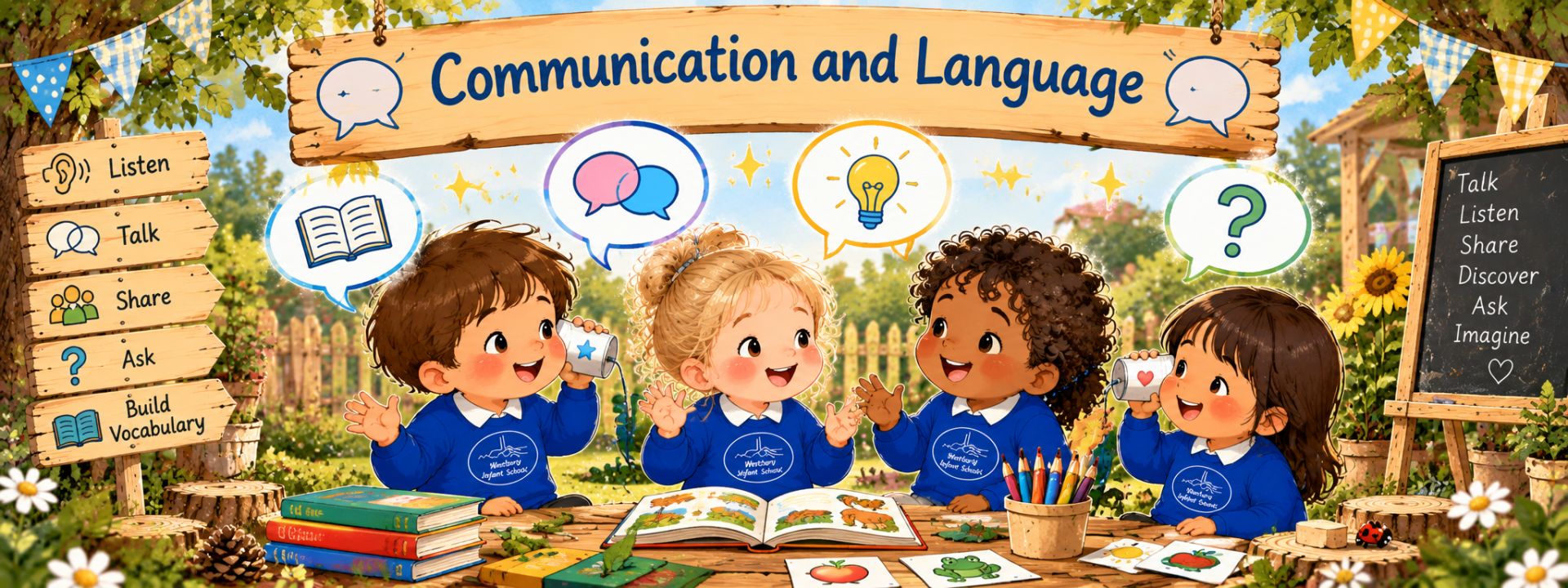
Communication and Language is at the heart of learning in Reception. Children use language to build friendships, share ideas, ask questions, solve problems and make sense of their experiences.
Throughout the year, children develop the confidence to express themselves and the skills to listen carefully to others. They encounter new words through stories, conversations, direct teaching, first-hand experiences and purposeful play.
A language-rich environment helps every child feel heard and valued. It also provides the foundation for reading, writing, mathematics and learning across the curriculum.
Communication and Language is organised into two connected areas:
- Listening, Attention and Understanding
- Speaking
What Happens in Reception?
Children develop their communication and language throughout the day.
They experience:
- conversations with adults and other children;
- high-quality interactions using the SHREC approach;
- daily stories and information books;
- songs, rhymes and Poetry Basket poems;
- Helicopter Stories;
- role play and imaginative play;
- group discussions;
- opportunities to describe experiences;
- carefully introduced curriculum vocabulary;
- questions that encourage thinking and explanation; and
- opportunities to perform and speak to different audiences.
Adults listen carefully to children, respond to their ideas and provide helpful models of language.
Children are given time to think and respond. Adults may repeat a sentence correctly, add new vocabulary or expand an idea without interrupting the flow of the conversation.
The SHREC Approach
Adults use the SHREC approach to support high-quality interactions.
Share Attention
The adult notices what has captured the child’s interest and focuses on it with them.
Shared attention helps establish a meaningful starting point for communication. The adult may look, point, comment or join the child’s activity.
Respond
The adult responds sensitively to what the child says, does or communicates.
Responses show the child that their ideas matter and encourage them to continue the interaction.
Expand
The adult builds upon the child’s words or ideas.
For example, if a child says, “The ice is gone,” the adult might respond, “Yes, the ice has melted because it became warmer.”
Expansion introduces new vocabulary, adds detail and models more complex sentence structures.
Conversation
The adult creates opportunities for a genuine back-and-forth exchange.
Rather than asking a series of questions, adults comment, pause, respond and give children time to develop their thinking.
These interactions support language, understanding, confidence and positive relationships.
Listening, Attention and Understanding
Learning to Listen
Listening involves more than being quiet. Children learn to focus on a speaker, understand what is being communicated and respond appropriately.
Children develop their listening skills through:
- stories;
- poems and rhymes;
- conversations;
- games;
- music;
- instructions;
- group discussions;
- role play; and
- practical activities.
They learn to:
- focus their attention;
- listen while another person is speaking;
- respond to what they have heard;
- follow instructions;
- remember important information;
- ask for clarification; and
- shift their attention when necessary.
Children’s ability to listen develops gradually. Adults provide clear expectations, visual support and repeated opportunities to practise.
Developing Understanding
Children learn to understand increasingly detailed language.
They are supported to:
- follow instructions containing more than one part;
- understand questions;
- identify important information;
- make connections with previous experiences;
- recall what happened;
- sequence events;
- explain why something occurred;
- predict what might happen next; and
- respond to ideas expressed by others.
Stories and first-hand experiences provide meaningful contexts in which children can develop their understanding.
Speaking
Developing Confidence
Children are encouraged to communicate in a range of situations.
They learn to:
- express their needs;
- share news and experiences;
- contribute to a group discussion;
- talk with friends during play;
- explain an idea;
- ask relevant questions;
- recount an event;
- retell a story;
- describe an observation;
- give a reason for an answer; and
- speak to a familiar audience.
Some children speak confidently from the beginning, while others need time, reassurance and smaller opportunities before contributing to a larger group.
Every form of communication is valued and supported.
Building Sentences and Connected Talk
Adults help children move from short responses towards increasingly detailed and connected speech.
Children learn to:
- speak in complete sentences;
- link ideas together;
- use words such as because, but, so, then and next;
- explain events in sequence;
- add relevant detail;
- use appropriate vocabulary;
- stay on a topic;
- respond to another person’s contribution; and
- adapt what they say for different situations.
Adults model language naturally within conversations rather than expecting children simply to repeat corrected sentences.
Developing Vocabulary
A broad vocabulary helps children understand new ideas and communicate precisely.
New words are introduced through:
- carefully selected books;
- curriculum teaching;
- practical experiences;
- visits and visitors;
- outdoor learning;
- songs, poems and rhymes;
- investigations;
- imaginative play; and
- everyday conversations.
Adults explain words, use them repeatedly and help children apply them in different contexts.
Children are encouraged to ask about unfamiliar words and experiment with using new vocabulary.
We distinguish between words children need to understand and words we want them to use confidently.
Stories, Rhymes and Poetry
Stories, songs, rhymes and poems help children become familiar with the patterns and possibilities of language.
Through listening and joining in, children develop:
- attention;
- vocabulary;
- memory;
- sequencing;
- rhythm and rhyme;
- expression and intonation;
- narrative language; and
- confidence when performing.
Poetry Basket
Through Poetry Basket, children learn and perform a carefully selected collection of poems throughout the year.
Actions, rhythm and repeated phrases help children remember and enjoy the poems.
Regular performance develops clear speech, expression, confidence and a shared enjoyment of language.
Helicopter Stories
We use Helicopter Stories to help children develop their own ideas and recognise themselves as storytellers.
A child tells a story to an adult, who writes down their words. The story is then shared and acted out by the children.
Helicopter Stories supports children to:
- organise ideas;
- create characters and events;
- use imaginative vocabulary;
- speak in increasingly detailed sentences;
- listen to other people;
- take turns;
- develop a shared narrative; and
- perform with confidence.
Because the adult records the child’s exact words, children see that their spoken language has value and can become written text.
Communication Through Play
Purposeful play creates natural reasons for children to communicate.
During play, children:
- negotiate roles;
- share resources;
- develop storylines;
- explain their ideas;
- solve disagreements;
- ask questions;
- make plans;
- give instructions;
- use language linked to different roles; and
- adapt their communication in response to others.
Adults enhance the environment with experiences, resources and vocabulary that deepen children’s talk.
They know when to observe, when to join the interaction and when to introduce a new word or idea.
Supporting Different Ways of Communicating
Children arrive in Reception with different experiences of language and communication.
Some children communicate confidently through speech. Others may use gesture, facial expression, signs, visual support or a communication system alongside spoken language.
Adults provide appropriate support so every child can:
- express choices;
- communicate needs;
- contribute ideas;
- build relationships; and
- participate fully in learning.
Home Languages
Families are encouraged to speak to their child in the language they know best.
A secure home language supports children’s thinking, identity, relationships and future language learning. Learning more than one language is an asset.
We value the words, stories, songs and experiences children bring from home.
Our Vision and Values
Communication and Language helps children live out our school vision and values.
Children belong when they know their voice is heard and their experiences are valued.
They thrive when they can express their needs, feelings and ideas.
They achieve when language enables them to understand, explain and apply new learning.
They play as they create stories, negotiate roles and communicate with others.
Children demonstrate respect by listening attentively and valuing different viewpoints.
They develop friendship and teamwork through conversation, cooperation and shared storytelling.
They show resilience when they keep trying to explain an idea or learn unfamiliar vocabulary.
They work towards excellence by listening carefully, speaking clearly and choosing increasingly precise language.
How Communication and Language Develops Across the Year
Across Reception, children move from:
- becoming familiar with classroom talk towards contributing confidently;
- listening for short periods towards sustaining attention for longer;
- following simple instructions towards understanding instructions with several parts;
- giving brief responses towards speaking in connected sentences;
- using familiar everyday words towards applying increasingly precise curriculum vocabulary;
- recounting immediate experiences towards explaining events in sequence;
- answering questions towards asking relevant questions of their own;
- describing what they notice towards explaining why something may have happened;
- joining in with familiar stories and rhymes towards retelling and performing them;
- developing an individual idea towards creating and sharing a complete story; and
- relying on adult prompts towards communicating with increasing independence.
Children develop at different rates. Adults adapt their language, interaction and support to meet each child’s needs.
How Can Families Help at Home?
Making Time for Conversation
- Talk about everyday routines as they happen.
- Give your child time to think and respond.
- Put phones and other distractions aside for short periods.
- Listen with interest.
- Comment on what your child is doing.
- Follow your child’s interests.
- Avoid asking too many questions in succession.
- Add a little more information to what your child says.
Asking Helpful Questions
Questions can encourage thinking, but conversations also need comments and pauses.
Try questions such as:
- “What did you notice?”
- “What do you think might happen?”
- “How did you do that?”
- “Why do you think that happened?”
- “What could we try next?”
- “How are these the same?”
- “How are they different?”
Allow enough time for your child to answer.
Sharing Stories and Experiences
- Share a story every day when possible.
- Talk about pictures, characters and events.
- Retell familiar stories together.
- Encourage your child to tell you about something that happened.
- Use photographs to help sequence an experience.
- Make up stories using toys or household objects.
- Visit the library and choose books together.
- Explain unfamiliar words.
Enjoying Songs, Rhymes and Poetry
- Sing familiar songs.
- Recite nursery rhymes.
- Encourage your child to perform Poetry Basket poems.
- Join in with actions and repeated phrases.
- Clap rhythms and listen for rhyming words.
- Make up your own silly rhymes.
- Celebrate confident speaking and performance.
Supporting Listening
- Play games involving instructions.
- Give directions in the correct order.
- Gradually increase the number of steps.
- Ask your child to repeat an instruction if needed.
- Play sound-identification games.
- Take turns when talking.
- Model looking towards the speaker without insisting on eye contact if this is uncomfortable for your child.
Using Your Home Language
- Speak in the language you know best.
- Share family stories, songs and rhymes.
- Teach your child words that are important to your family and culture.
- Talk about new experiences in your home language.
- Continue developing the home language while your child learns English.
Our Communication and Language Progression Documents
The documents below provide more detail about the knowledge and skills taught throughout Reception.
- View our Communication and Language curriculum and progression document
- View our Oracy Progression Document
Talk to Us
Please speak to your child’s class teacher if you have questions about their listening, understanding, speech, language or confidence when communicating.
Sharing information about how your child communicates at home helps us provide consistent and appropriate support.
By working together, we can help every child become a confident listener, thoughtful speaker and enthusiastic communicator.