 Our Reception Curriculum
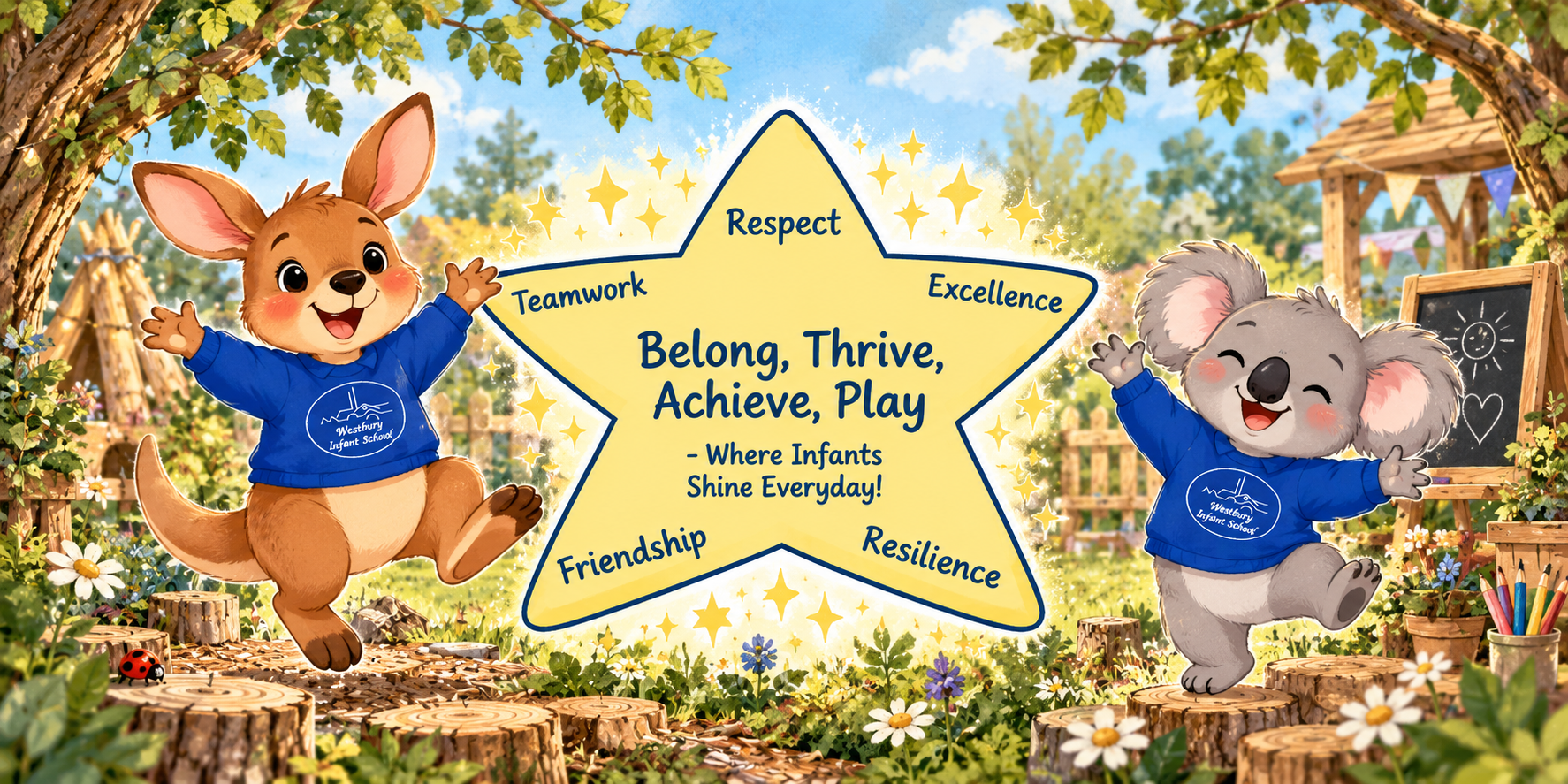
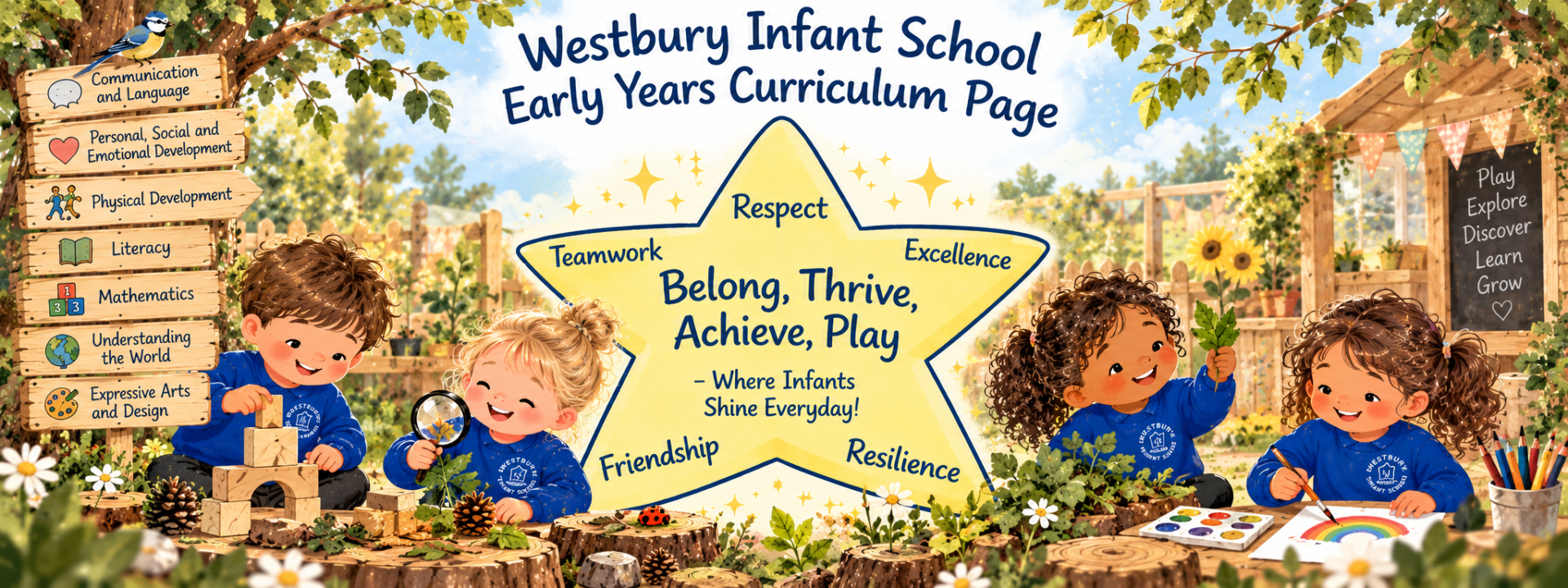
Belong, Thrive, Achieve and Play
Reception is an exciting year of discovery, friendship and growing independence. Children become confident members of our school community as they explore new ideas, develop important skills and experience the joy of learning through purposeful play, high-quality teaching and first-hand experiences.
We want every child to feel happy, secure and ready to make the most of all that Reception has to offer.
At Westbury Infant School, we want every child to:
- Belong by feeling safe, included and valued;
- Thrive through positive relationships, confidence and wellbeing;
- Achieve through an ambitious curriculum and appropriate support; and
- Play as they explore, practise, imagine and make sense of their learning.
Our values of respect, excellence, resilience, friendship and teamwork are woven throughout the Reception curriculum. They shape our relationships, learning environment and expectations for how children learn and play together.
How Children Learn in Reception
Children learn through a carefully balanced combination of:
- explicit teaching;
- purposeful play and exploration;
- continuous provision;
- planned enhancements to the environment;
- high-quality interactions with adults;
- first-hand experiences;
- practical activities;
- stories, songs, poems and rhymes; and
- indoor and outdoor learning.
Teachers identify the important knowledge, skills and vocabulary children need to learn. They teach these directly and plan enhancements that allow children to explore, revisit and apply their learning.
Enhancements may include carefully selected resources, books, vocabulary, questions, problems or experiences. They are chosen purposefully in response to the curriculum and children’s learning needs.
High-Quality Interactions
Adults use the SHREC approach to support children’s communication, language and thinking:
- Share attention: noticing and focusing on what interests the child;
- Respond: responding sensitively to what the child says, does or communicates;
- Expand: building upon the child’s words, ideas and understanding; and
- Conversation: encouraging meaningful back-and-forth exchanges.
Adults know when to observe, when to join children’s play and when to provide direct teaching or additional support.
Our Year in Reception
Our curriculum develops progressively across six half terms. New learning builds upon what children already know, while important knowledge and skills are revisited and applied in different contexts.
Autumn 1: Belonging and Noticing Change
Children settle into Reception, build relationships and become familiar with classroom routines.
They explore questions including:
- Who am I and where do I belong?
- What do we notice in the place around us?
- How have people grown and changed?
- What happens as autumn begins?
Children talk about themselves, their families and their personal past. They explore the school and local environment, notice early signs of autumn and begin developing early knowledge of number, shape and comparison.
Stories and practical experiences support children to talk about belonging, feelings, friendship and difference.
Key experiences include home visits, joining the school community and exploring the outdoor environment.
Autumn 2: Our Community and Special Times
Children strengthen their relationships, communication and independence.
They explore questions including:
- What roles do people have in our community?
- How and why do people celebrate special times?
- What changes as autumn becomes winter?
- How can familiar stories help us tell and retell?
Children learn about people who help within the community and explore different celebrations. They observe seasonal changes and develop their storytelling, sequencing and vocabulary.
Mathematics continues through practical exploration of number, pattern, shape and measure.
Key experiences include a community encounter, the Nativity and Christmas celebrations.
Spring 1: Change, the Past and the Wider World
Children develop their questioning, observation and explanation skills.
They explore questions including:
- How can objects and materials change?
- What can old and new toys tell us?
- What can we find out about life in another country?
- What helps us care for ourselves and keep trying?
Children compare toys from the past and present using objects, photographs and memories. They encounter contemporary life in India through maps, photographs and information texts.
They investigate freezing and melting, deepen their understanding of materials and develop healthy choices and perseverance.
Key experiences include exploring old and new toys, learning about India and investigating ice and water.
Spring 2: Growth, Animals and Special Places
Children observe growth and change through sustained first-hand experiences.
They explore questions including:
- How do living things grow and change?
- What do animals need?
- How can we find things out by looking closely and using information?
- Why are some places special to people?
Children plant and care for seeds, learn about animals and their environments and use non-fiction books to find information.
They learn about Easter and explore why some places are special to Christians. Encounters with other places of worship are supported through stories, images, information or visitors.
Key experiences include planting and caring for seeds, an animal encounter and a visit to All Saints Church.
Summer 1: Journeys, Maps and Life Cycles
Children apply their learning with increasing independence and use more detailed language to explain their ideas.
They explore questions including:
- How do journeys help us understand places and routes?
- How can we represent and describe our local area?
- What can close observation tell us about a life cycle?
- How do people use ideas, stories and creativity to make something new?
Children observe the caterpillar-to-butterfly life cycle, explore Westbury through a local walk and begin using simple maps.
They use evidence to investigate the local area in the past and present and learn about Mae Jemison as a significant person.
Drawing Club begins during the summer term, giving children opportunities to apply their phonic knowledge and develop their own ideas through drawing and writing.
Key experiences include observing real caterpillars, completing a local walk and exploring maps.
Summer 2: The Seaside, the Natural World and Transition
Children connect and apply their learning with increasing independence.
They explore questions including:
- How is the seaside similar to and different from Westbury?
- What can evidence tell us about seaside holidays in the past?
- How can we care for the natural world?
- How can we reflect on our journey and look ahead to change?
Children compare Westbury with the seaside using first-hand observations, maps and photographs. They investigate how seaside holidays have changed and learn about the marine environment.
Children also reflect upon their Reception journey and prepare positively for their transition to Year 1.
Key experiences include a beach visit and opportunities to become familiar with Year 1.
Learning That Continues Throughout the Year
Across the year, children experience:
- daily Read Write Inc. Phonics;
- sequenced teaching of handwriting, spelling and writing skills;
- high-quality stories read aloud;
- rich conversations, vocabulary, rhyme and poetry;
- Mastering Number and practical mathematics;
- regular outdoor learning and seasonal observation;
- daily movement and frequent physical challenges;
- music, movement and imaginative play;
- creative exploration;
- increasing independence and responsibility; and
- purposeful use of technology when it enriches learning.
Read Write Inc. Phonics
We use Read Write Inc. Phonics to teach reading and writing systematically.
Children learn to recognise sounds, blend sounds to read words and segment words for spelling. They read books closely matched to the sounds they have learned and reread them to develop accuracy, fluency and confidence.
Find out more about Read Write Inc and Writing
https://www.westbury-inf.wilts.sch.uk/Phonics-and-Early-Reading/
https://www.westbury-inf.wilts.sch.uk/Writing/
Mastering Number
We use Mastering Number to help children develop a secure and flexible understanding of number.
Children explore quantities, number composition, numerical relationships and patterns through practical resources, visual representations and mathematical conversations.
Find out more about Mathematics and Mastering Number.
https://www.westbury-inf.wilts.sch.uk/Maths/
Explore the Seven Areas of Learning
Follow the links below to find out what happens in each area, how families can help at home and how learning progresses throughout Reception.
- Communication and Language
- Personal, Social and Emotional Development
- Physical Development
- Literacy
- Mathematics
- Understanding the World
- Expressive Arts and Design
Our Reception Long-Term Plan
Our long-term plan provides further detail about:
- the planned lines of enquiry;
- the main learning for each half term;
- key experiences and encounters;
- seasonal opportunities;
- our focus texts; and
- how important strands of learning build across the year.
View or download the Reception Long-Term Plan 2026–27
The long-term plan sits alongside our curriculum and progression documents. These explain the full curriculum and show how children’s knowledge and skills develop throughout Reception.
Assessment in Reception
Assessment is mainly based on teachers knowing children well.
Adults notice what children know, understand and can do through conversations, observations, play, practical activities, direct teaching and independent work.
This information helps teachers decide what children need to learn next. Assessment should not place unnecessary pressure on children.
At the end of Reception, teachers complete the statutory EYFS Profile. The Early Learning Goals are used as part of this assessment, but they do not represent the complete Reception curriculum or everything children are taught.
Working with Families
Families know their children best. We encourage parents and carers to share their child’s interests, experiences, achievements and needs with us.
Termly Overviews and Building Blocks
At the beginning of each term, we produce a termly overview so families can see the learning, experiences and key texts planned for their child.
We also share our Building Blocks, which explain what we hope children will know, understand and be able to do by the end of the term. These help parents and carers understand how learning develops and identify everyday opportunities to support it at home.
The termly overviews and Building Blocks are shared on our class blog pages.
Kangaroo Class Blogs Koala Class Blogs
Learning Squares
Every child has a Learning Square displayed in the classroom. This celebrates achievements, special experiences and memorable moments from both school and home, helping children feel proud of who they are and what they can do.
Parents and carers can contribute by emailing photographs and a short description to the class email address. This might include:
- learning a new skill;
- visiting a special place;
- taking part in a family or cultural celebration;
- receiving an award;
- showing kindness or independence;
- overcoming a challenge; or
- an experience your child is excited to share.
These contributions help us recognise learning beyond the classroom and give children valuable opportunities to talk about their lives and achievements with others.
Each curriculum-area page also contains practical suggestions for supporting learning at home. These are designed to fit naturally into family life rather than create additional formal work.
If you have questions about your child’s learning, development or wellbeing, please speak to their class teacher.
By working together, we can help every child belong, thrive, achieve and play.
Useful Links for Parents and Carers
These trusted resources provide further information about the Early Years Foundation Stage and practical ideas for supporting children’s learning and development.
EYFS Statutory Framework
The official Department for Education document setting out the requirements for children’s learning, development, assessment, safeguarding and welfare.
Read the EYFS statutory framework
What to Expect in the Early Years Foundation Stage
A parent-friendly guide to children’s learning and development across the seven areas of the EYFS. This guide was previously called What to expect, when?
Read What to Expect in the EYFS
Official EYFS Overview
A short government overview of the seven areas of learning and the assessment arrangements at the end of Reception.
BBC Tiny Happy People
Ideas, videos and activities to support children’s communication and language through everyday conversations and play.
Words for Life
Free activities, book suggestions and advice from the National Literacy Trust to support speaking, listening, reading and writing.
BookTrust
Reading advice, book recommendations and enjoyable activities for children and families.