Expressive Arts and Design in Reception
Expressive Arts and Design is the area of the EYFS that supports children’s creative development.
Reception is filled with opportunities to imagine, design, make, sing, move, perform and tell stories. Children discover that there are many ways to express an idea and that their choices can communicate something unique.
Creativity is not about producing identical finished pieces. It is about exploring possibilities, learning techniques, making purposeful choices and developing the confidence to share an individual response.
Through art, design, music, movement, storytelling and imaginative play, children learn to experiment, solve problems and bring their ideas to life.
Expressive Arts and Design is organised into two connected areas:
- Creating with Materials
- Being Imaginative and Expressive
What Happens in Reception?
Children experience creative learning through:
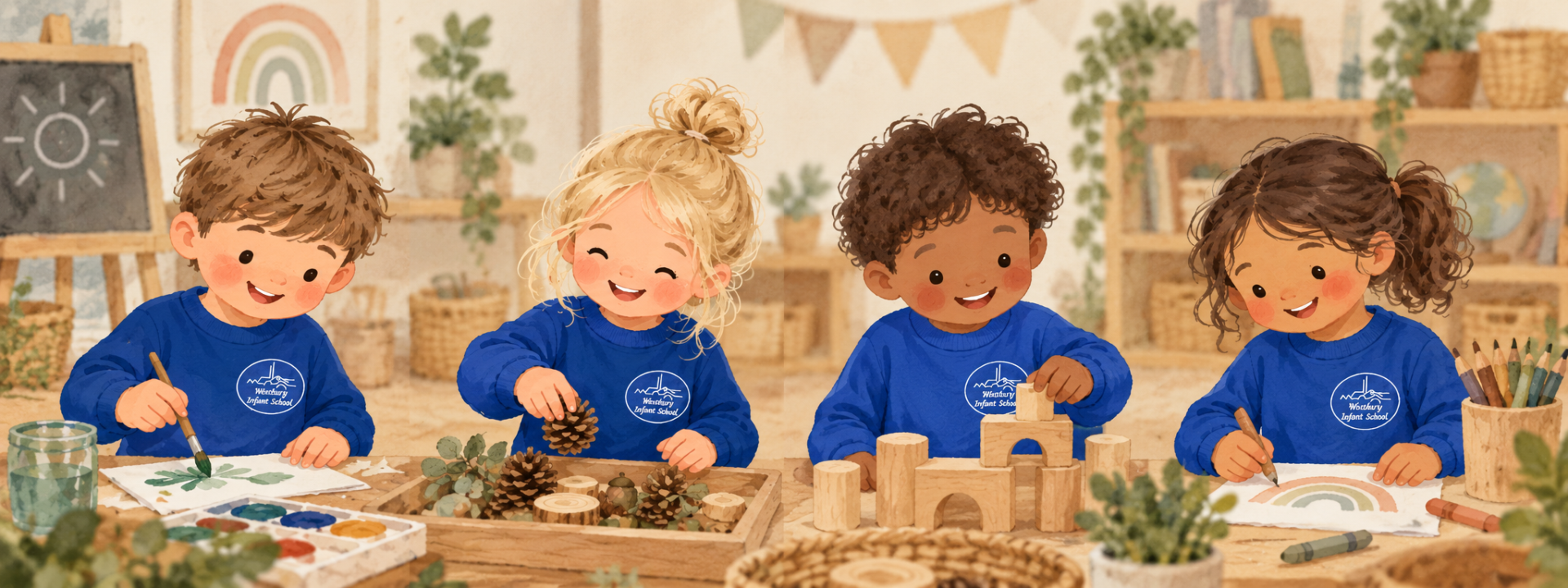
- drawing and painting;
- collage and printing;
- modelling and sculpture;
- construction;
- designing and making;
- music and singing;
- rhythm and percussion;
- movement and dance;
- storytelling;
- role play;
- small-world play;
- drama and performance; and
- responding to artists, makers and musicians.
Adults teach children how to use tools, materials and techniques safely and effectively. The learning environment is enhanced with carefully selected materials and creative challenges.
Children are given time to explore, practise, revisit and improve their ideas.
Creating with Materials
Exploring Materials and Tools
Children encounter a broad range of materials and learn about their different properties.
They explore:
- pencils, crayons and chalk;
- paint and ink;
- paper and card;
- fabric and thread;
- clay and modelling materials;
- natural and recycled materials;
- construction equipment;
- joining materials;
- brushes, rollers and printing tools; and
- child-safe scissors and other tools.
Children learn how materials feel, move and respond. They begin to recognise that different materials are suitable for different purposes.
Adults introduce the correct vocabulary for tools, materials and techniques and demonstrate how to use them safely.
Drawing and Painting
Children use drawing and painting to observe, imagine and communicate.
They learn to:
- explore line, shape, colour and texture;
- make different kinds of marks;
- select suitable drawing tools;
- mix and combine colours;
- use brushes with increasing control;
- draw from observation;
- draw from memory and imagination;
- represent people, places and objects;
- add detail; and
- revisit and develop their work.
Children encounter the work of artists and makers to broaden their experience and introduce new possibilities. They are encouraged to notice and discuss what they see rather than copy a predetermined outcome.
Designing, Making and Constructing
Children learn that designing and making involve thinking, choosing, testing and improving.
They have opportunities to:
- develop an idea;
- talk about what they want to make;
- select suitable materials;
- join materials in different ways;
- create simple props;
- build structures;
- test whether a construction is strong enough;
- solve practical problems;
- adapt a design when something does not work; and
- explain the choices they have made.
Children begin to consider the purpose of what they are making and who might use it.
Construction experiences help children develop creativity, physical control, mathematical thinking and problem-solving.
The Creative Process
We value the process of creating as much as the finished result.
Children are encouraged to:
- explore before deciding;
- make their own choices;
- try different possibilities;
- take creative risks;
- learn from mistakes;
- return to an idea;
- make changes;
- combine familiar techniques;
- talk about their work; and
- appreciate the work of others.
Adults may teach a specific skill or technique, but children are then given opportunities to apply it in their own way.
Being Imaginative and Expressive
Imaginative Play
Imaginative play allows children to explore experiences, relationships and ideas.
Through role play and small-world play, children:
- create characters;
- invent settings;
- develop storylines;
- take on different roles;
- use objects symbolically;
- negotiate ideas with others;
- recreate familiar experiences;
- explore possibilities; and
- solve problems together.
Enhancements to the environment introduce new props, stories, vocabulary and experiences that deepen children’s play.
Children may create their own props, signs, costumes or settings, linking imaginative play with art, design and writing.
Storytelling and Drama
Children develop their imagination and confidence through oral storytelling, role play and performance.
Helicopter Stories gives children opportunities to create their own stories, see their words recorded and act out stories together.
Through storytelling and drama, children learn to:
- develop characters and events;
- organise ideas into a simple narrative;
- use expressive language;
- listen to the ideas of others;
- take on a role;
- use facial expression and movement;
- perform with increasing confidence; and
- collaborate within a group.
During the summer term, Drawing Club provides further opportunities for children to create characters, settings and adventures through drawing, talk and writing.
Music and Singing
Children experience music as listeners, performers and creators.
They learn to:
- listen attentively;
- join in with familiar songs;
- remember melodies and words;
- explore pulse and rhythm;
- copy a simple rhythm;
- respond to changes in music;
- play percussion instruments;
- explore different sounds;
- perform with others; and
- create their own musical ideas.
Children learn that music can communicate different moods, ideas and experiences.
Regular singing, rhyme and Poetry Basket performances support children’s memory, language, rhythm and confidence.
Movement and Dance
Children respond to music and ideas through movement.
They have opportunities to:
- move in different ways;
- respond to rhythm and tempo;
- copy movements;
- remember a simple sequence;
- express an idea or feeling through movement;
- create their own movements;
- move with a partner or group; and
- perform for others.
Dance supports creativity as well as physical development, listening and cooperation.
Our Vision and Values
Expressive Arts and Design provides rich opportunities for children to live out our school vision and values.
Children belong when their ideas, experiences and creative responses are valued.
They thrive when they have the confidence and freedom to explore and express themselves.
They achieve as they develop skills, revisit their work and recognise their progress.
They play as they imagine, create stories, take on roles and explore possibilities.
Children demonstrate respect by valuing different ideas and responding positively to other people’s work.
They develop friendship and teamwork when they create, perform and solve problems together.
They show resilience when a material, technique or design does not work as expected.
They work towards excellence by practising skills, making thoughtful choices and taking pride in their work.
How Expressive Arts and Design Develops Across the Year
Across Reception, children move from:
- discovering materials and tools towards selecting them purposefully;
- exploring different marks towards drawing with greater observation, control and detail;
- experimenting with colour towards mixing and choosing colours for a purpose;
- joining materials with support towards selecting effective joining techniques;
- building simple structures towards testing, strengthening and adapting constructions;
- exploring creative possibilities towards planning and explaining their choices;
- joining in with familiar songs and rhymes towards remembering and performing them confidently;
- copying rhythms and movements towards creating their own;
- engaging in simple role play towards sustaining and developing shared narratives;
- retelling familiar stories towards inventing characters, settings and events;
- relying on adult suggestions towards independently selecting, combining and adapting ideas; and
- talking about what they have made towards reflecting on how it could be developed.
Children develop at different rates. Creative opportunities and support are adapted so every child can participate, express ideas and experience success.
How Can Families Help at Home?
Drawing and Making
- Provide paper and a selection of drawing tools.
- Encourage drawing from observation and imagination.
- Paint, print or make collages together.
- Use boxes and recyclable materials for models.
- Build with blocks or construction toys.
- Explore modelling dough or clay.
- Talk about the materials your child has chosen.
- Ask your child to explain what they have made.
- Encourage them to return to and develop an idea.
- Display or photograph creations that are important to them.
Supporting the Creative Process
Instead of asking only “What is it?”, try questions such as:
- “Can you tell me about your idea?”
- “How did you make this part?”
- “Why did you choose that material?”
- “What was difficult?”
- “How did you solve the problem?”
- “What might you add or change?”
- “Which part are you most pleased with?”
Allow your child to make their own choices. Avoid showing them that there is only one correct way to create something.
Music and Singing
- Sing familiar songs together.
- Encourage your child to perform Poetry Basket poems.
- Clap and copy simple rhythms.
- Make sounds using household objects.
- Listen to different kinds of music.
- Talk about how music makes you feel.
- Move or dance in response to music.
- Create a simple family performance.
- Attend appropriate live music events where possible.
Imaginative Play and Storytelling
- Encourage pretend play using everyday objects.
- Provide old clothes, bags or fabric for dressing up.
- Create stories using toys or puppets.
- Invite your child to tell a story while you write down their words.
- Act out familiar or invented stories together.
- Ask what might happen next.
- Create props, tickets, signs or maps for a game.
- Allow your child to lead the play and develop their own storyline.
Building and Designing
- Build towers, bridges, homes or vehicles.
- Talk about what a structure needs to do.
- Encourage your child to choose suitable materials.
- Test whether the model is strong or stable.
- Ask what they could change if it does not work.
- Celebrate problem-solving and perseverance.
- Allow time to rebuild and improve.
Our Expressive Arts and Design Progression Documents
The documents below provide more detail about the knowledge and skills taught throughout Reception.
Talk to Us
Please speak to your child’s class teacher if you would like more information about creative learning or ideas for supporting a particular interest at home.
By working together, we can help children become imaginative thinkers, confident performers and purposeful creators.