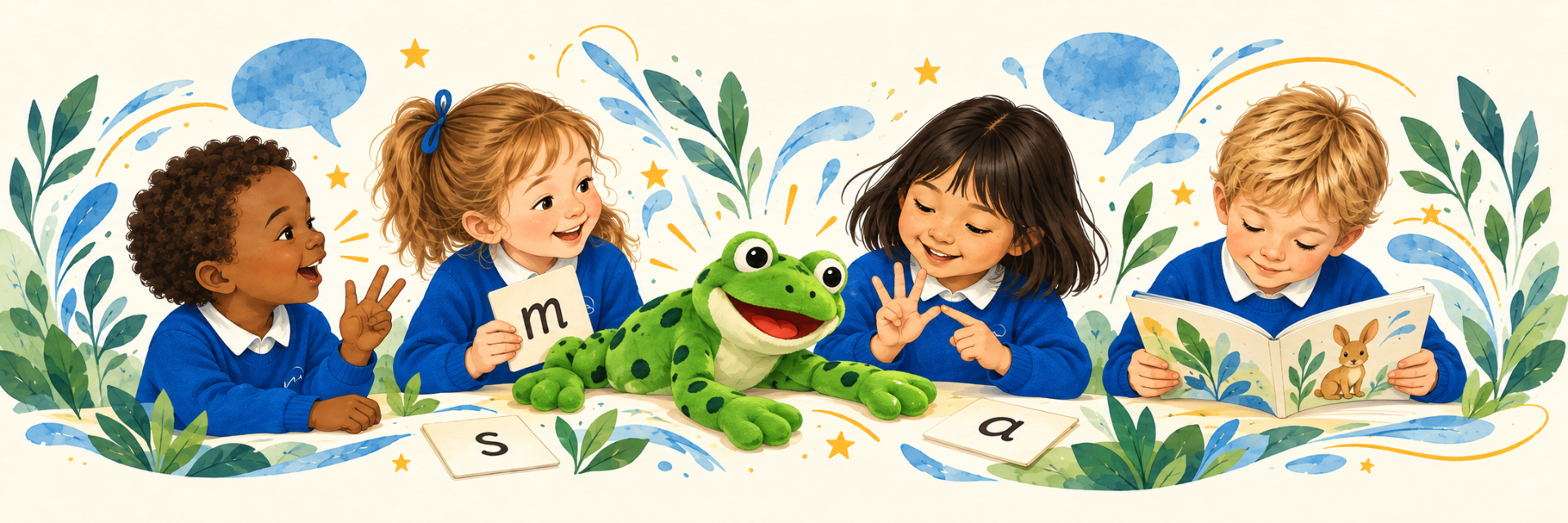
Phonics and Early Reading at Westbury Infant School
At Westbury Infant School, we teach early reading through Read Write Inc. Phonics, a systematic synthetic phonics programme. Children learn to recognise sounds, blend them to read words and segment spoken words into sounds for spelling.
The programme provides a carefully structured route from learning the first sounds to reading increasingly complex words and books with accuracy, fluency and understanding. Consistent routines help children become confident readers and writers.
Children are taught in groups closely matched to their current reading knowledge. These groups are reviewed regularly so that teaching responds to what children know and what they need to learn next. During lessons, children participate actively by saying sounds, reading words, discussing texts and reading with a partner.
How Read Write Inc. works
Children learn:
- to recognise letters and groups of letters and say their corresponding sounds;
- to blend sounds together to read words;
- to segment spoken words into sounds for spelling;
- to read words containing familiar sounds with increasing speed;
- to read common words containing unusual spellings;
- to read carefully matched books with accuracy and fluency;
- to understand and discuss what they have read;
- to form letters using the Read Write Inc. handwriting guidance.
The sounds children learn
Children learn the Read Write Inc. Speed Sounds in a carefully structured sequence. They begin with Set 1 and progress to Sets 2 and 3 when they are ready.
The RWI pictures and phrases used in school help children remember each sound and form the corresponding letter or letters correctly.
Set 1 Speed Sounds
Single-letter sounds
m a s d t i n p g o c k u b f e l h r j v y w z x
Special Friends
sh th ch qu ng nk ll ff ss ck
“Special Friends” is the RWI term for two or more letters that work together to represent one sound.
Set 2 Speed Sounds
ay ee igh ow oo oo ar or air ir ou oy
The two oo spellings represent different sounds, as heard in zoo and look. The Set 2 ow sound is heard in a word such as blow.
Set 3 Speed Sounds
Children learn alternative ways of representing familiar sounds and increasingly complex sound-spelling correspondences.
ea oi a-e i-e o-e u-e aw are ur er ow ai oa ew ire ear ure tion tious cious
For example:
- ow as in brown;
- tion as in station;
- tious as in cautious;
- cious as in precious.
Children learn that the same sound can be represented by different letters or groups of letters. They also learn to identify longer sound-spelling correspondences within multisyllabic words.
Additional sounds
Children are also taught these additional sound-spelling correspondences:
ue ie au e-e kn wh ph e
For example:
- ue as in blue;
- ie as in pie;
- au as in August;
- e-e as in these;
- kn as in knee;
- wh as in whisk;
- ph as in phone;
- e as in he.
Children meet these sounds through carefully matched RWI teaching, reading materials and practice. They learn to notice which letters represent the sound and apply this knowledge when reading and spelling unfamiliar words.
Children are not expected to learn all the sounds at once. Teaching and practice are matched to each child’s current stage in the programme.
Fred Talk and blending
Fred the Frog can only speak in sounds. Children help Fred by blending the sounds together to say the whole word:
c-a-t → cat
This is called Fred Talk.
As blending becomes more automatic, children learn to use Fred in your head. They silently blend the sounds before saying the whole word. This supports increasingly fluent reading.
Green Words and Red Words
Green Words contain sound-spelling correspondences that children have been taught. Children can use Fred Talk to decode these words.
Red Words contain an unusual or not-yet-taught sound-spelling correspondence. Children learn to identify the unusual part of the word and practise reading it accurately.
Books matched to children’s phonics
Children read RWI Storybooks that are closely matched to the sounds and words they know. This allows them to practise successful decoding without being asked to guess words from pictures or context.
Children reread their books to develop:
- accurate decoding;
- automatic word recognition;
- an appropriate reading pace;
- expression;
- understanding of vocabulary;
- comprehension and confident discussion.
Rereading is an important part of learning to read. Each reading has a different focus and helps children move from careful decoding towards fluent and expressive reading.
Alongside their phonics books, children regularly hear high-quality stories, poems and information books read aloud. This develops their vocabulary, knowledge, comprehension and enjoyment of reading while their independent decoding continues to grow.
Assessment and additional practice
Children are assessed regularly so that teaching can be matched closely to their current knowledge and next steps. Assessment helps staff identify sounds or reading skills that require further practice and organise teaching groups effectively.
Targeted additional practice is prioritised according to assessed need. It may include extra rehearsal during the school day, focused small-group work, brief individual support or carefully selected practice at home.
Children continue to receive the phonics teaching and practice they need until they can read accurately and fluently.
The Year 1 Phonics Screening Check
Children usually complete the statutory Phonics Screening Check in Year 1. The check asks children to read a mixture of real words and pseudo-words using their phonics knowledge.
The check helps confirm whether children have learned the phonics skills expected by the end of Year 1. Children who need more time continue to receive appropriate phonics teaching and complete the check again in Year 2.
Supporting phonics and early reading at home
Families can help by:
- listening to their child read regularly;
- encouraging them to identify the Special Friends, Fred Talk and then read the word;
- allowing time for their child to blend rather than supplying the word immediately;
- rereading familiar books to build fluency and expression;
- practising the sounds and words currently being taught;
- sharing and enjoying stories, poems and information books together;
- talking about new vocabulary, characters, events and ideas;
- celebrating effort, perseverance and progress.
It is important to pronounce sounds clearly without adding an extra “uh” sound. For example, say a short, crisp m, rather than “muh”.
Resources in children’s reading folders
Relevant Read Write Inc. QR-code resources are shared in children’s reading folders each half term. These include:
- Fred Talk videos;
- Set 1 Speed Sounds;
- Set 2 Speed Sounds;
- Set 3 and additional sounds.
These resources demonstrate the correct pronunciation and RWI routines used in school. Families should use the materials currently identified for their child rather than trying to teach every sound at once.
Useful links for families
- Ruth Miskin Training – Support for Parents and Carers
Official films explaining phonics, Fred Talk, blending, handwriting and reading RWI Storybooks. - Oxford Owl – Read Write Inc. Phonics Guide
Information about the programme, Speed Sounds and ways to support reading at home. - Oxford Owl – Free eBook Library
Families can create a free account to access a selection of eBooks.
Our curriculum documents
The following documents provide further information about phonics and early reading at Westbury Infant School:
- Reading and Phonics Knowledge and Skills Progression
- Westbury Infant School RWI Progression Route
- Reading Spine