Writing at Westbury Infant School
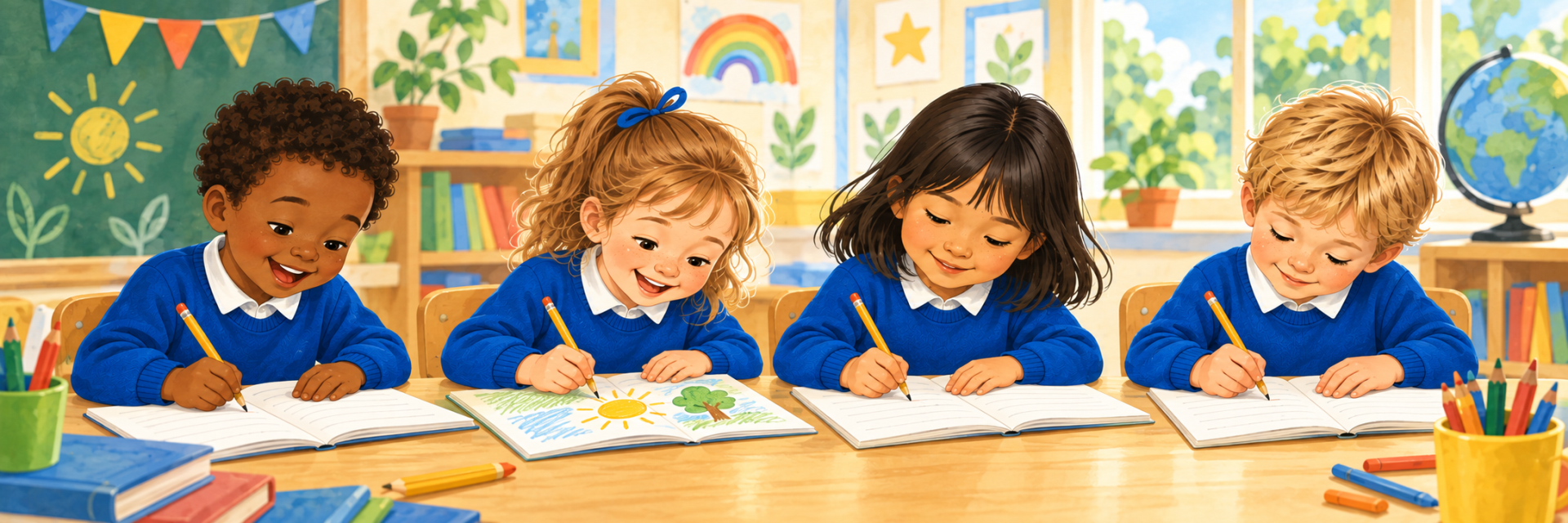
At Westbury Infant School, we want every child to see themselves as a writer: someone who has ideas worth sharing and the growing knowledge and skills needed to communicate them clearly.
Learning to write involves several things happening together. Children need ideas, vocabulary and an understanding of how written language works. They must also learn to form letters fluently, spell words and construct sentences. Our curriculum therefore develops both composition—thinking of, organising and communicating ideas—and transcription—handwriting and spelling.
Children are supported to say what they want to write before writing it. Through stories, purposeful talk, play, drama, drawing, modelled writing and shared writing, they develop the language and confidence needed to become increasingly independent writers.
How we teach writing
Our writing curriculum is built around high-quality stories, poems and information texts. These introduce children to rich vocabulary, memorable characters, interesting ideas and different ways in which writers communicate with their readers.
Children write for meaningful purposes and audiences. They may write to entertain, inform, explain, describe, persuade or record. They encounter stories, recounts, instructions, letters, poems and information writing, but teaching does not centre on memorising lists of genre features. Instead, children learn to make appropriate choices according to what they want their writing to achieve.
A writing sequence may include:
- enjoying and discussing a high-quality text;
- learning and using new vocabulary;
- exploring characters, events, information and ideas through talk and play;
- hearing an adult think aloud while modelling writing;
- orally composing and rehearsing sentences;
- completing shared and supported writing;
- receiving explicit teaching about sentence construction, grammar or punctuation;
- planning and drafting;
- rereading and improving writing;
- checking spelling and punctuation;
- producing an independent written outcome for a clear purpose.
Not every piece of writing follows every stage. Teachers adapt the sequence according to the children, the text and the intended outcome.
Writing in Reception
Writing begins with communication, storytelling, drawing, movement and play. In Reception, children are immersed in songs, rhymes, poems, stories and high-quality conversations that develop their imagination, vocabulary and understanding of language.
Each week, a carefully selected text provides opportunities for rich discussion, storytelling and response. Approaches such as Helicopter Stories and Poetry Basket help children create, retell and perform stories, rhymes and poems. Adults follow children’s interests and encourage them to use talk, drawing, symbols, letters and words to communicate their ideas.
Children develop the physical foundations for handwriting through purposeful movement, play and practical activity. Squiggle Whilst You Wriggle supports the transition from large whole-body movements to the smaller controlled movements needed for writing.
Through Read Write Inc., children learn to:
- hear and identify sounds in spoken words;
- link sounds to letters;
- form letters using consistent RWI guidance;
- blend sounds to read words;
- segment words into sounds for spelling;
- write familiar words and short phrases;
- rehearse and write increasingly complete sentences.
Children are encouraged to write throughout the learning environment for purposes that make sense to them. This may include labels, messages, lists, signs, captions, maps, stories and explanations.
The emphasis is not on producing large amounts of writing before children are ready. It is on securing the language, phonics, letter formation and confidence that will allow children to become successful writers.
Writing in Years 1 and 2
At the beginning of Year 1, Drawing Club provides a familiar bridge from Reception into the KS1 writing curriculum. It combines high-quality texts, purposeful talk, drawing, vocabulary and sentence writing while teachers establish expectations for handwriting, spelling and sentence construction.
Children then move into sustained, text-led writing sequences. A shared high-quality text allows all children in the mixed Year 1 and Year 2 class to explore the same characters, language and ideas. Teaching and written outcomes are adapted so that expectations remain appropriate for each year group and each child’s stage of development.
Across Years 1 and 2, children learn to:
- generate, discuss and organise ideas;
- compose sentences orally before writing;
- sequence sentences so that meaning is clear;
- select vocabulary appropriate to the intended effect;
- write for a known purpose and audience;
- apply taught spelling, handwriting, grammar and punctuation;
- reread writing to check that it makes sense;
- make purposeful additions or changes;
- proofread for errors appropriate to their stage;
- develop the stamina and independence needed to complete increasingly sustained writing.
Year 1 children are supported to secure the foundations of writing, including oral composition, spacing, letter formation, phonically plausible spelling and the accurate construction of simple sentences.
Year 2 children build on these foundations. They develop greater control over sentence structure, vocabulary, cohesion, punctuation, spelling and the organisation of a complete piece of writing.
Transcription: spelling and handwriting
Transcription is explicitly taught because children need increasingly automatic spelling and handwriting to concentrate fully on their ideas.
Spelling
Children apply their phonics knowledge as their first strategy for spelling unfamiliar words. In RWI lessons, they learn to segment words using Fred Fingers, spell taught words and complete Hold a Sentence activities. These routines help children remember a sentence, spell its words and reproduce it accurately.
Year 1 children continue to follow the RWI progression. Year 2 children remain within RWI for as long as they need its systematic phonics teaching. When children are secure and ready to move beyond the phonics programme, spelling teaching develops their knowledge of the statutory Year 2 spelling patterns, word structures and common exception words.
Children learn to:
- identify the sounds in a spoken word;
- select plausible graphemes for those sounds;
- spell words containing taught sound-spelling correspondences;
- recognise and remember the unusual parts of common exception words;
- add taught prefixes and suffixes;
- notice patterns and relationships between words;
- use classroom resources to support spelling;
- check and correct spellings they have been taught.
Spelling expectations are matched to what children have been taught. An attempt that represents the sounds accurately is valued while the child continues to learn the conventional spelling.
Handwriting
We use the Read Write Inc. handwriting approach so that children experience consistent language, letter formation and expectations across phonics and writing.
Children develop:
- appropriate posture and paper position;
- a comfortable and effective pencil grip;
- controlled movements;
- accurate formation of lower-case letters;
- appropriate formation of capital letters and digits;
- consistent letter size and orientation;
- appropriate spacing between words;
- increasing fluency, stamina and presentation.
The priority is secure, efficient and legible letter formation. Children are not hurried into joining before their letter formation and pencil control are sufficiently secure.
Grammar and punctuation
Grammar is taught as knowledge that helps children communicate meaning. Teachers introduce grammatical structures explicitly, model them in sentences and give children opportunities to practise and apply them within purposeful writing.
Children may briefly rehearse a sentence pattern or punctuation skill separately before applying it to their own writing. Grammar is revisited through reading, discussion, modelled writing, shared writing and independent composition.
In Year 1, children develop secure foundations in sentence construction, spacing between words, capital letters, sentence punctuation, joining ideas using and, and singular and plural forms.
In Year 2, children build on these foundations by learning about different sentence purposes, nouns, verbs and adjectives, expanded noun phrases, coordination and subordination, consistent tense, commas in lists and apostrophes for contractions and singular possession.
In mixed Year 1 and Year 2 classes, children may explore the same text and writing purpose while receiving grammar teaching appropriate to their year group and current stage of development. Grammar is taught purposefully so that it helps children make their writing clearer, more precise and more effective.
The complete year-by-year grammar and punctuation progression can be found in our Writing Curriculum, Knowledge and Skills Progression.
Poetry
Children regularly hear and enjoy poems, songs and rhymes. Poetry develops vocabulary, listening, memory, rhythm, performance and an appreciation of how language can be selected for effect.
Dedicated poetry teaching gives children opportunities to:
- listen and respond to poems;
- learn and perform poems aloud;
- explore rhythm, rhyme, repetition and word choice;
- play with language;
- compose and present their own poems.
Modelling and feedback
Teachers make the writing process visible. During modelled writing, the teacher thinks aloud so that children can hear how a writer chooses vocabulary, constructs sentences, checks meaning and makes improvements.
Shared writing enables children to contribute ideas while the teacher supports the class to shape them into effective written language. Scaffolds are used when they help children access learning and are gradually reduced as independence grows.
Feedback is timely, manageable and closely connected to what has been taught. It may be given through discussion, live marking, whole-class feedback, partner work or a short individual conference. Children are not expected to correct every feature of every piece. Feedback prioritises the next step that will make the greatest difference.
Assessing writing
Teachers assess writing through everyday observation, discussion and children’s work across the curriculum. Assessment considers both what children can do independently and the knowledge they demonstrate during supported practice.
Teachers consider children’s developing control of:
- oral composition and vocabulary;
- organisation and sequencing of ideas;
- sentence construction;
- grammar and punctuation;
- spelling;
- handwriting;
- rereading, checking and improving;
- independence and stamina.
Assessment identifies what has become secure and what needs further modelling, teaching or practice. Teachers moderate writing together to develop consistent expectations across Reception, Year 1 and Year 2.
Helping your child at home
Families can support writing without turning it into a test or correcting every attempt. Helpful activities include:
- talking together and introducing interesting new words;
- sharing stories, poems and information books;
- encouraging your child to retell familiar stories;
- making up stories together;
- drawing and talking about ideas before writing;
- writing cards, labels, lists, invitations, messages and notes;
- providing pencils, pens, chalk, paint and other materials;
- encouraging your child to say a sentence aloud before writing it;
- helping your child use Fred Fingers to identify the sounds in a word;
- praising ideas, effort and progress;
- asking your child to read their writing aloud;
- modelling writing by letting your child see adults write for real purposes.
If a child asks how to spell a word, encourage them first to identify the sounds they can hear. For words containing unusual spellings, it is helpful to supply or model the correct spelling.
Writing should remain purposeful and enjoyable. Young writers need encouragement, conversation and regular opportunities to communicate—not every spelling or letter corrected at once.
Click here for Information for Families on how we teach Writing from Reception to Year 2Useful websites for families
- Oxford Owl – Writing
Guidance about how writing develops and practical suggestions for supporting children at home. - Oxford Owl – Writing in Year 1
An explanation of Year 1 writing expectations and age-appropriate home activities. - Oxford Owl – Writing in Year 2
An explanation of Year 2 writing expectations and ways families can help. - Oxford Owl – Handwriting
Advice and activities to support pencil control, letter formation and handwriting. - Ruth Miskin Training – Parents and Carers
Official RWI films about spelling, handwriting, phonics and supporting children at home. - Words for Life – Activities for Children Aged 5 to 8
Enjoyable activities that support storytelling, language, reading and writing.
Our curriculum documents
The following documents provide further information about writing at Westbury Infant School:
- Writing Curriculum, Knowledge and Skills Progression: Reception to Year 2
- Reception Writing Curriculum Overview
- KS1 Writing Curriculum Overview – Year A
- Handwriting Knowledge and Skills Progression
Spelling, transcription, grammar and punctuation progression are included within the main writing curriculum and progression document so that families can see how the different elements of writing develop together.